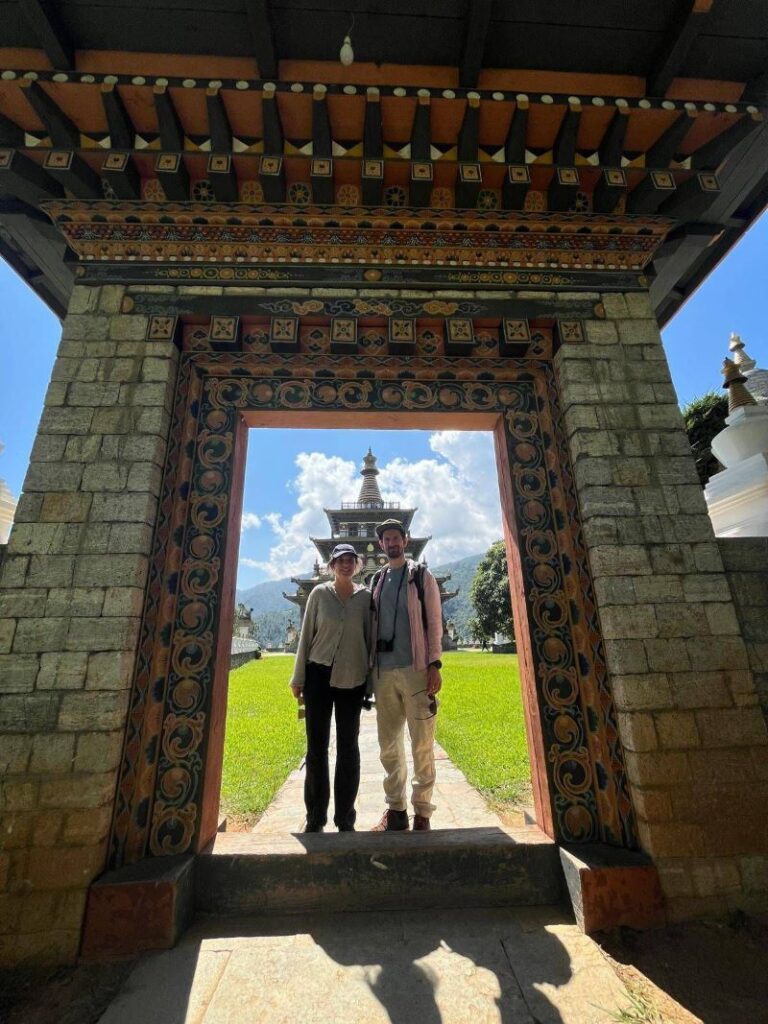
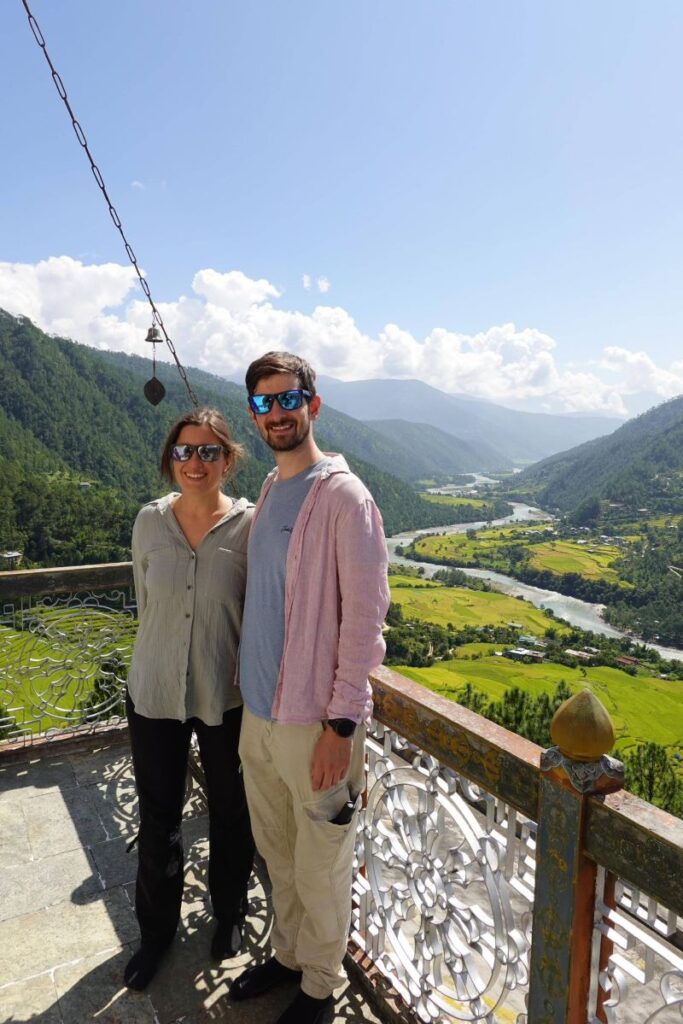
Overall we were more than satisfied with our Bhutan trip and it was better than we had expected.
Day 1 – Colourful Bhutan
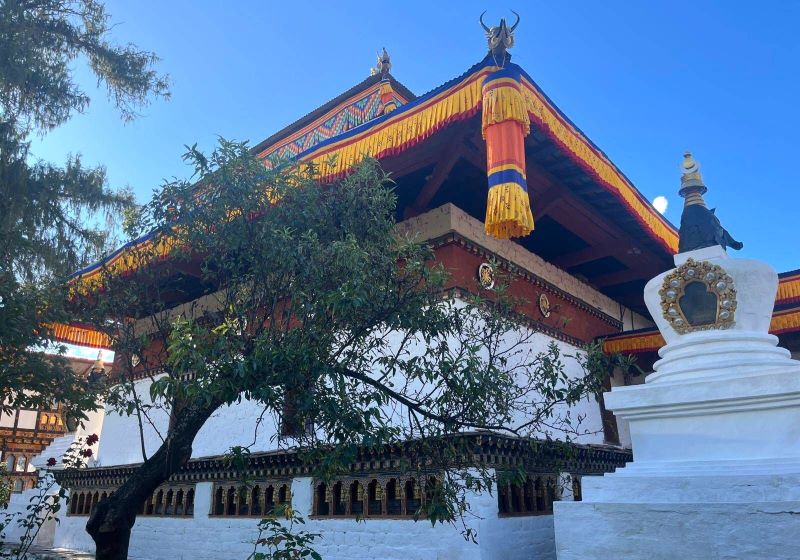
Before the spectacular landing approach to Paro, we caught an impressive glimpse of Mount Everest. Hardly had we landed, the first points of the programme of our Bhutan trip began. The first thing we got to visit was the Buddhist temple Kyichu Lhakhang. The temple was built in the 7th century by Songtsen Gampo, the 33rd Tibetan king. The temple is particularly important because it is one of the 108 temples built to subdue a demon lying on Tibet and the Himalayan region.
After that we learned quite a bit about Bhutan’s history and Buddhism in the National Museum of Bhutan.
Before lunch we also visited the Dzong in Paro. This is a building in which one half houses the administration and the other the religious centre of the respective district. Bhutan is a constitutional monarchy, so there is a king but also a parliament.
After lunch we took it a bit easier with a short walk through the market.
The chillies on the roofs, by the way, are typical for Bhutan. They are left on the roofs and dried in any weather for 3 months.


Day 2 – With the nuns
On our second day in Bhutan we drove from Paro to Punakha. On the way we crossed the 3,150m high Dochula Pass. Once on top, in good weather you can see all the high Himalayan mountains. We will probably have to hope for better weather on the second crossing. On the pass there is a memorial for the victims of the war in 2003. In this war, the Bhutanese army fought against a part of the Indian army that had turned against the Indian government. We explored the memorial and a small trail with viewpoints in a mystical atmosphere through the fog. Down in the valley towards Punakha we enjoyed our lunch with a wonderful view. After the meal we walked on foot through the rice fields to the Chimi Lhakhang temple. Finally we visited the Sangchhen Dorji Lhuendrup nunnery. We were allowed to observe how a Buddhist master gave a lesson to the young nuns.


Day 3 – Butter tea and puffed rice
Today we started with a small hike to the temple built for the current king. In the temple we were able to watch a Buddhist master reading scriptures accompanied by instruments. From the roof of the temple we were rewarded with a fantastic view for the climb. On the roof we were allowed to take photos. That is forbidden inside temples.
After the descent we headed to a farm for lunch. There we enjoyed typically Bhutanese food for the first time. The highlights were chilli with cheese (yes, in Bhutan chilli is not eaten as a spice but as a vegetable), butter tea and the homemade rice wine we were allowed to try after the meal.
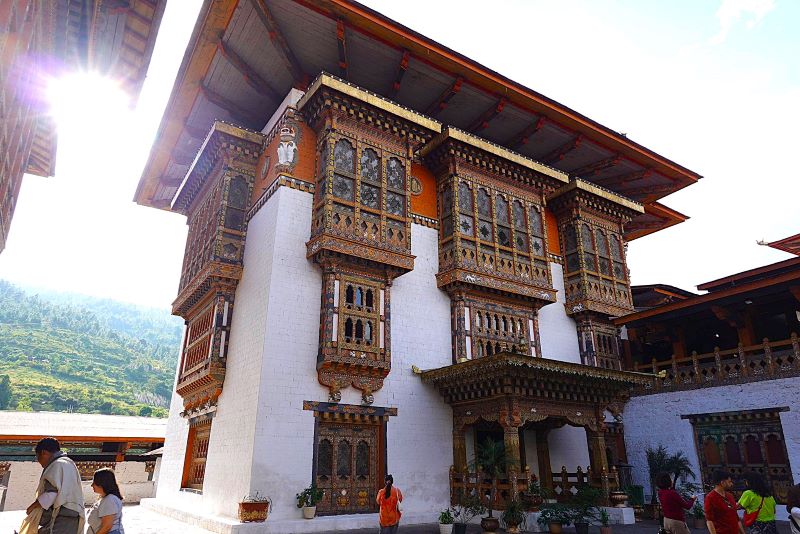
In the afternoon we visited the Punakha Dzong, which is responsible for the administration of the Punakha district. This is the second dzong built in Bhutan, and very significant. The location is also impressive. It lies where the two rivers Mo Chhu (“female river”) and Pho Chhu (“male river”) meet. The dzong has been damaged several times in the past by floods and fire and rebuilt. The paintings and decorations are very elaborate and were very impressive to us!
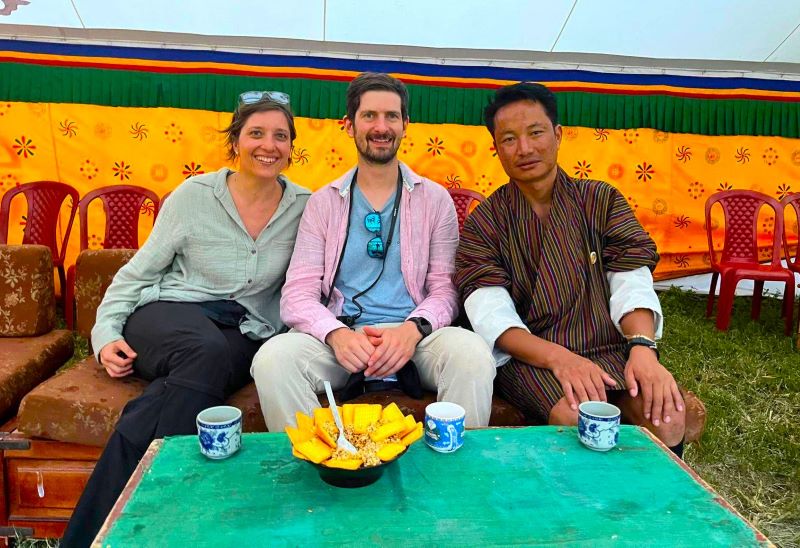
To get a bit of movement in after the dzong, we went to a suspension bridge over the Pho Chhu, the longest suspension bridge in Bhutan. After a brief visit to the market, we were allowed a glimpse of a week-long festival of monks, at which the population could pray for a positive future or lay down burdens through offerings. We too were allowed to take part and pave the way for our loved ones and ourselves into the future through small offerings. Afterwards we once again experienced the hospitality in Bhutan and were invited to butter tea, the national drink, and puffed rice.
Day 4 – Drive over the Pelela Pass
Today we drove from the west of Bhutan to the centre of the country to Trongsa. The drive lasted 4-5 hours. On the way, however, we experienced quite a lot!
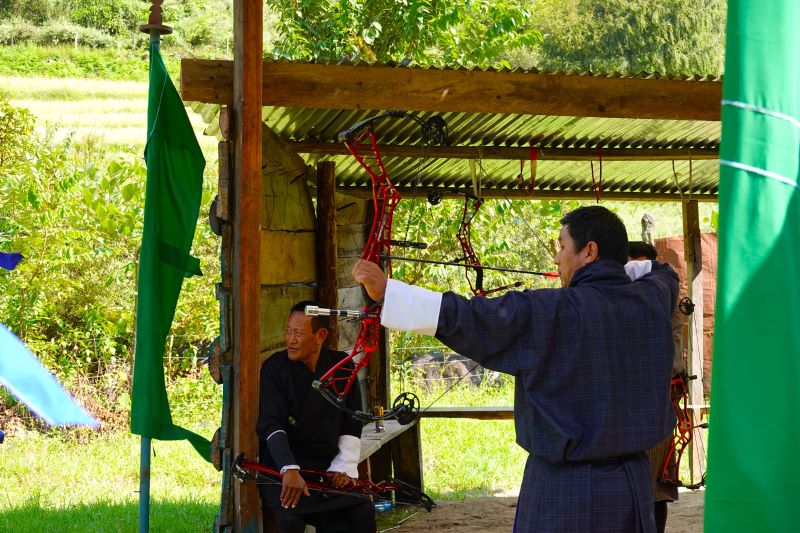
Bhutan’s national sport is archery. At our first stop we were able to be right in the middle of a competition. Two teams compete against each other. Two targets are set up 150 m apart in a small shelter. The teams shoot in both directions. Part of the team stands around the target in the shelter, protected behind wooden walls, and indicates to the shooters whether and how well they hit. When a shooter hits the target, this is celebrated with a dance and song. The men clearly had fun! The high-tech bows cost a lot of money, which is why it is not a sport for children, but rather for the adults who can no longer play football anyway. Our otherwise rather quiet driver really came alive, as he is apparently quite good at archery.
After that we went high up into the mountains to the top of the Pelela Pass at 3,440m. The nature and view from the pass road were fantastic! On top of the pass there is a small temple and 108 red flags. The flags are red because a different form of Buddhism is practised in the region.
On the pass we tried dried yak cheese for the first time. It is chewed slowly like a kind of chewing gum. On the descent, still with the yak cheese in our mouths, we saw a yak for the first time.
Lunch we were able to enjoy once again in a dreamy setting. Particularly tasty were the potatoes from the region and the mushrooms.
Once arrived in Trongsa, we visited the Trongsa Dzong. We particularly liked this dzong! The location is very imposing and the atmosphere was mystical. Halfway through our visit it started to rain. The dzong in Trongsa appears older and more original than the others we have visited so far. Probably this is because the last renovation is somewhat further back, meaning the paintings are not so new. The atmosphere was great!
In the dzong our guide explained the wheel of life to us and told us the stories behind other Buddhist images.

Day 5 – Emmental cheese in Bhutan
Today we woke up to an impressive atmosphere. It was very foggy. At times we could make out the Dzong of Trongsa, which we could see wonderfully from our hotel room, through the fog. After breakfast the next 3,400m high pass, the Yotongla, was on the programme. At the top we made a short stop at the small stupa before driving down into the Bumthang region. Bumthang stands for “beautiful women”. On the way down we covered a few hundred metres on foot to enjoy the wonderfully fresh air and the beautiful forest. Down in the valley we visited a small weaving workshop. The cloths made from the wool of young yaks are extremely soft to the touch! We were allowed to admire the looms and were shown how they dye the wool. All with 100% natural dyes, some of which they gather in the forest.
After lunch we visited the Dzong of Bumthang. This dzong bears the name Jakar Dzong, which translates as “white bird”. There really were many birds flying around the tower of the dzong, only no white ones. This dzong seemed somewhat simpler and smaller than the others, but nevertheless had a great atmosphere and a beautiful garden with lovely flowers. The dzong, built in the 16th century, was built on the mountain for defence. One peculiarity is the access to a spring from inside the dzong in case of a siege. The way down to the spring was very adventurous. We went down extremely steep wooden staircases inside small towers and steep stone steps protected between castle walls, partly in the dark. Since we had to take the same way back up, we definitely had our cardio training for the day! It’s hardly imaginable how the people used to haul water up the around 300 steps.
Before we drove to our hotel, our guide also showed us the shop of the “Bumthang Swiss Cheese” dairy. A Swiss man, who has lived in Bhutan for a long time and married a Bhutanese woman, produces Emmental and “Swiss” Gouda from cow’s milk here. The Emmental is really tasty! The region has also benefited from his knowledge in other respects. He brought along quite a bit of know-how from western culture. For example, he explained to the people here that it makes sense to let the cows move from pasture to pasture, as this makes the grass fuller. Previously the cows ran around freely as in other valleys. You can tell from the cows here that they have more on their ribs.
Day 6 – In search of happiness
Today we set ourselves the task of visiting the three temples of the Bumthang valley. If you manage this in one day, it is said to bring happiness.
We started with a small “hike”, actually more of a long walk, to the first of the three temples, to one of the oldest, the Tamshing Lhakhang. On the way we saw many hemp plants by the roadside that used to be fed to the animals. For a long time it was not known that this plant can be smoked. Today marijuana is illegal in Bhutan. How much is nevertheless smoked is not known.
This first temple was very impressive, as the paintings have never been restored, meaning the originals from the 14th century can still be admired. It is “only” the innermost part of the temple from the 14th century. Over time the building was extended. So today the old part is, as it were, completely wrapped up as a “house” within a “house”. We were allowed to walk through a corridor around the original temple wearing a heavy chain cloak in order to lay down our burdens and sins.
We continued to the Kurjey Lhakhang temple. The first three kings of Bhutan found their final resting place here. Currently a three-day Buddhist festival is taking place at this temple. For this, offerings, fruit and other foodstuffs had been set up and many Buddhist masters were also present. During our visit to the inner temple rooms, we were blessed by two important Buddhist masters. After the lunch break of the monks, we had the unique opportunity to attend a ceremony with the masters and numerous monks of all ages. We sat inside the temple at the edge while they all chanted mantras together, partly accompanied by instruments such as bells, special drums, but also wind instruments such as flutes and shells. The atmosphere in this temple was absolutely magical! We were the only tourists who attended this ceremony, although there were a few other groups on the grounds. For us this was so far one of the highlights of our Bhutan trip – a real goosebumps moment. After the ceremony we were invited to butter tea and puffed rice.
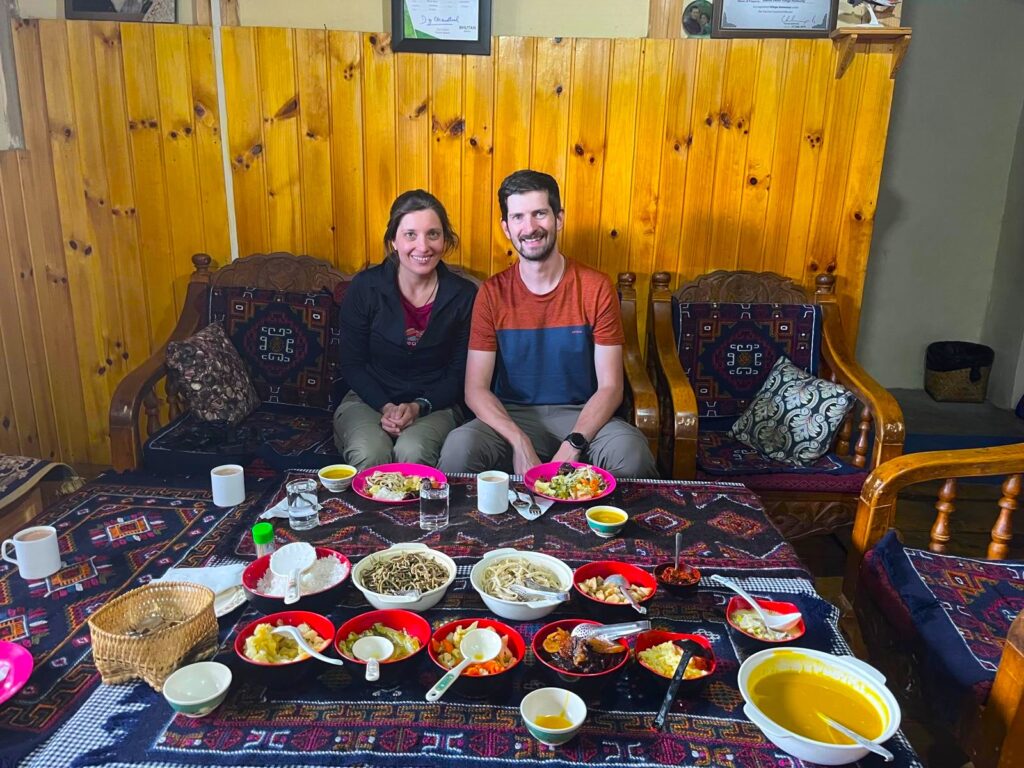
Lunch was for the second time on a farm. Tasty local dishes had been prepared for us. In general we find the food on the farms much more authentic and tasty than in the restaurants. This time our guide and the driver ate with us, which was nice as they usually always let us eat alone, presumably because our food is not spicy enough for them. After the meal we were allowed to try our hand at archery with a traditional bow. Our driver showed us how to handle the bow. That is his element! Besides archery we also played the Bhutanese version of darts. There too our driver was by far superior to everyone.
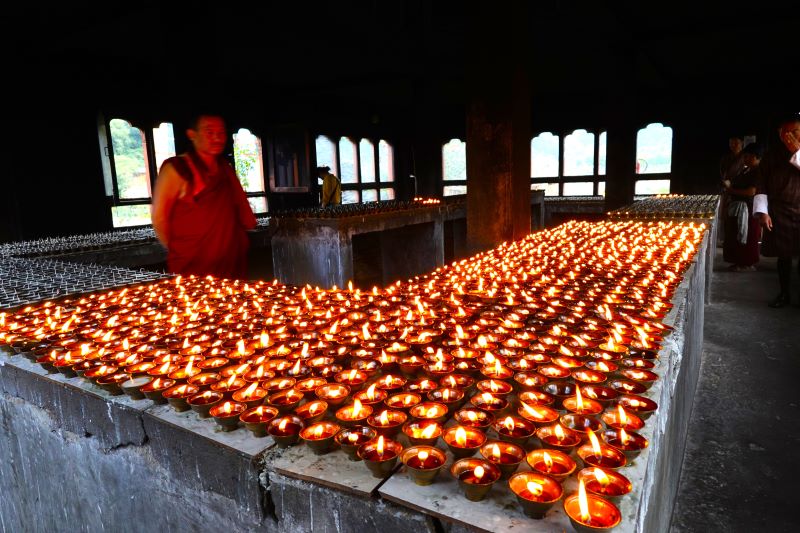
In the afternoon we visited the Jamphel Lhakhang temple. This is the second temple in Bhutan of the 108 temples built by the 33rd Tibetan king. In this temple too, the paintings were not restored. So we were able to admire paintings from the 7th century! It was very impressive. After the visit we also went to the butter lamp house and lit butter lamps.
Back to the hotel we again took a short walk. That was very exciting, as it was just end-of-day time and there was a lot of the life of the people of Bhutan to see. Schoolchildren on the way home, children playing in front of shops, people on the streets running errands.
Day 7 – Day of ceremonies
Today started with a longer drive through the mountains into the Tang Valley. The drive was spectacular! Wherever you look, there are forests. In this region they are mainly coniferous forests. So far we had only seen mixed forest here. In the middle of the mountains, rice is even grown at an altitude of 2,600m! It’s a special rice variety from Japan that has been bred especially for this altitude. “Normal” rice would not grow here. At a brief stop, we were able to watch a family harvesting the rice. To separate the rice grains from the stalks, they used a foot-powered machine. It was a drum that spins fast, onto which they held bunches of the rice stalks to knock the grains out. In other regions we had so far only observed the conventional method, in which they beat bunches of the stalks on a stone, which looks very strenuous.
Our first destination was the Ogyen Choling Museum, which was exciting! It was located in a kind of castle and also had a temple. We learned quite a bit about life in Bhutan. Exciting tools for woodworking, leather working, agriculture, etc. were on display. Kitchen utensils such as pots, water storage and noodle presses were also on view. Also interesting was the still used to make rice schnapps. Of course battle gear such as swords, bows and arrows, shields and rifles were also represented.
At the museum we also ran into the Swiss man already mentioned. He and his wife enjoy high regard here in the region.
After lunch, which was very tasty and exceptionally without chilli, we visited the temple. In the upper temple room suddenly a lot was going on. Men and boys had put on traditional clothes and were preparing for a ceremony. We were allowed to be right up close. First up in the temple, then down on the square. The aim of the ceremony was to awaken a local deity that is supposed to protect the people of the region. Offerings were also made for this. Besides food, these were a dog, two horses and an ox (in former times a rooster was also part of it). Today these animals are no longer killed, but only decorated and led in a procession around the temple three times, which all the spectators were supposed to follow – so we did too. Meanwhile loud shouting took place in order to call the deity. Throughout the whole ceremony there was a relaxed and exuberant mood. There was a lot of laughter. Outside we were allowed to take photos.
Before we set off on the return journey, we were able to watch a group of Bhutanese women dancing and singing.
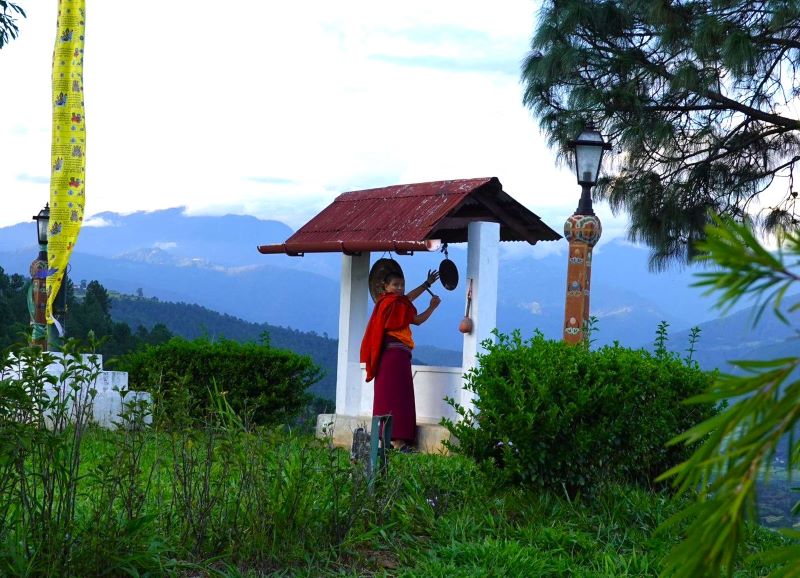
On the way back we also visited the Pema Choling nunnery. We were lucky as the nuns were just preparing for a ceremony. Right when we arrived we were served tea and a cracker. That’s typical in Bhutan, that guests are served tea – usually butter tea. After that it began. For about an hour mantras were sung – in the course of the ceremony accompanied by more and more instruments. The atmosphere was very beautiful! The nuns of the highest rank sat closest to the master’s chair. The nun of the highest rank had a microphone and led the mantras. The nuns who had only recently entered the monastery sat at the edge near us and followed the whole thing, but had no active role. One of the very young among them (about 6 years old) came into the temple room after the beginning of the ceremony and sat down very close to us (we sat at one wall of the temple near the corner and the nun sat down at the other wall near the same corner). Under her robe she had smuggled in a young kitten. Sometimes the kitten wanted to run away, sometimes it enjoyed the petting hidden under lots of fabric. Whenever the discipline master came by, the young nun hid the kitten and put on a serious face. Afterwards she smiled at us mischievously. At the end, everyone present, so us too, was given a sip of rice wine in their hand and we were allowed to take a blessed pastry and an “Alpenliebe” candy from a bowl.
After the ceremony we headed back towards the hotel with a brief stop at a small natural reservoir of a river. This small lake has great significance for the people in Bhutan. In Buddhism people believe in reincarnation. Several hundred years ago, when a master claimed to be reincarnated, he was not believed. As proof, he then pulled a Buddha statue and a butter lamp out of the water of this small lake.
Day 8 – In the valley of the cranes
Today we travelled from the Bumthang to the Phobjikha Valley, so back across the Yotongla and Pelela Pass. “La” has two meanings, on the one hand pass, on the other “La” is appended to words to show respect to the other person. As an example “Kuzuzangpo” means hello, but it is more respectful to greet people with “Kuzuzangpo La”.
On the descent from the Yotongla Pass we had a nice wildlife encounter. We saw a red pheasant. A beautiful bird! Unfortunately very shy and quick, so our wildlife photographer was far too slow… As is actually always the case with the beautiful birds here, except for the crows. The frustration was driven away after a few curves, however, because suddenly we found ourselves in the midst of a horde of monkeys. The monkeys too are not easy subjects from inside the car. Unfortunately our guide didn’t let us get out, as he said they would be aggressive. One or two not too unfocused photos came out of it nevertheless.
After the Pelela Pass we visited the beautiful Gangtey Monastery. Young monks live in this monastery. It is essentially a primary school. We were allowed to watch the monks studying for a while. They all sat in the temple and read from old scriptures. Each had a stack in front of him and read aloud from it to himself. We are not sure whether all of them were reading different texts or simply not at the same pace, but it sounded like a huge mishmash. And yet somehow it was calming. At the end of the lesson everyone spoke a closing text together, which sounded much more harmonious. When the discipline master struck the floor with his whip, everyone jumped up and streamed off for the break. We then had the opportunity to visit the temple. Our guide drew our attention to a flute made from a human bone that is still in use. We were visibly horrified that something like that is still possible nowadays. He said that today it is also very difficult to obtain bones and so experiments with wood are being carried out, but they would not have the same sound. He also enlightened us that the wine we received yesterday at the nunnery had also been served from a human skull. When we then came out of the temple into the courtyard of the monastery, it began to rain. This was apparently rather unimportant to some of the young monks. They continued to play with a small ball in the courtyard even in the rain. The monastery building was interesting because the complex is currently being renovated. So you saw parts that had just been freshly painted, but also old paintings and parts of the building that had been newly rebuilt and not yet painted at all.
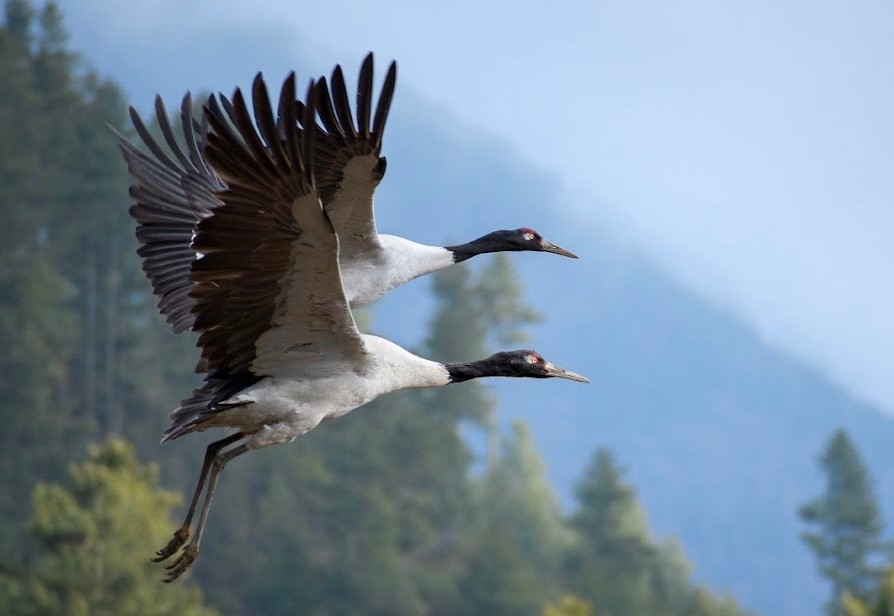
From the monastery to our hotel today we took a short hike through a wonderful forest. After about 2/3 of the way we stood before a magnificent plain with a small river meandering through the middle. A fantastic view! From November onwards, the cranes that come from Tibet overwinter on this plain. Our guide’s description was promising. Unfortunately we had to be content with the cows and horses. But this sight too was unique for us!
Tomorrow morning we can admire the plain once more. Our hotel room is perfectly placed for that.
Day 9 – The giant Buddha
Today we started the day with a beautiful sunrise (even though, due to the western orientation of our room, we could only see the rays of the sun wandering down the mountain). A longer drive of 135 km to the capital Thimphu was on the agenda, which with the local road conditions took about 5-6 hours. There are cows and dogs on the roads everywhere. You especially have to swerve around the cows, as they don’t voluntarily move from the spot. There are no expressways such as we know them. Only winding mountain roads with potholes. So you only move forward slowly. But for that there is always something to see. Today we saw monkeys again! A whole family of Hanuman langurs. This time we had the opportunity to watch them a little. The young ones were romping about in the trees, the older ones rather sat cosily in the trees or by the roadside. Some were eating something, one was grooming the fur of one of the young. Our guide said that such encounters are rather unusual. Normally these monkeys are very shy and not to be found on the roads.
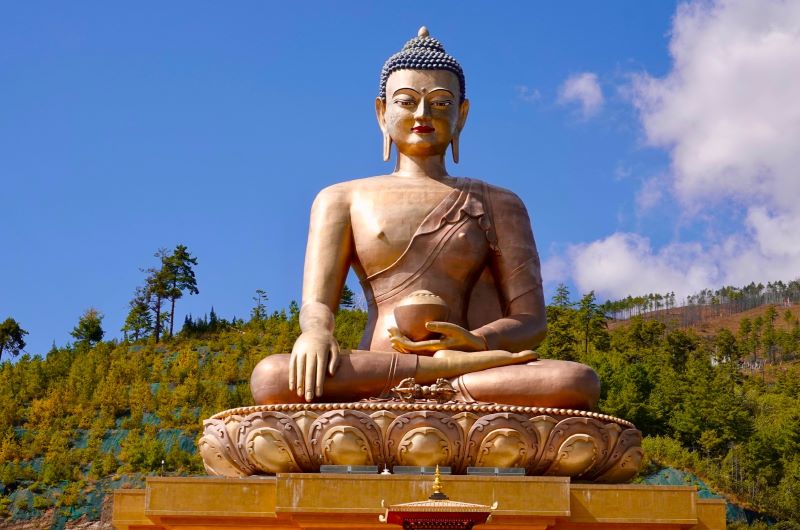
Arriving at Thimphu we visited the 51.5 m high Buddha Dordenma statue. The statue is positioned very prominently on the mountain. When you look up from below, you see only sky behind the statue. The entire construction of the statue was sponsored among others by Rinchen Peter Teo, a businessman from Singapore, and cost over 100 million USD. The construction is still ongoing, whereby the ground floor was already opened to celebrate the 60th birthday of the 4th king of Bhutan, the father of the current king, and is accessible to the public. The inside of the statue is a temple. The atmosphere, however, is not comparable to the old temples we have visited so far. Impressive is the huge quantity of small Buddha statues displayed inside. There are said to be over 100,000. We didn’t count them. But it really is a lot!
On the way back down to the city we briefly stopped at a spot with a good view over the city. Thimphu as the capital has about 100,000 inhabitants and is the only “big city” in Bhutan (in total about 700,000 inhabitants). Conspicuous is that most roofs are green and some red. The houses with the red roofs belong to the authorities, the green ones are privately owned. The still white ones will still be painted green or red. Also missing are the chillies on the roofs. This is presumably because most houses contain rental apartments and the roofs are not accessible to the residents.
Day 10 – Looking into the stars
Today movement was on the menu: the last training for tomorrow’s hike to the Tiger’s Nest. The first of our two small hikes led us through an enchanting forest to a small temple and a monastery. We did not cover much distance, but a few metres of altitude. On the way we had pure wildlife around us! We met three hordes of monkeys, small squirrel-like animals, birds and wild goats. The odd good photo came of it too.
At the top we caught sight of a really small temple built into the rock. The way there was not for the faint of heart. First it went up very steep stairs on the slope, and then on ladders where with a rucksack you could hardly fit through the opening. The view from the top was worth all the effort though! In the temple a monk was stationed who looks after a master who is currently praying in complete isolation for 3 years. In the rock above the temple room there is a small cave that offers just enough space for two people. In this cave the “founder”, who unified Bhutan in the 17th century, meditated. We also had the opportunity to meditate there for a few minutes and listen to the sounds of the monk’s drum from the temple room obliquely below. After visiting the small temple room and being allowed to roll a dice for our luck (we both only got mediocre values), our guide showed us a small cave below the temple. In this cave an important Buddhist master was cremated. In the rock you can see his footprint. Before going back down into the valley, we also visited the Tago Monastery higher up, which is significantly easier to access and bigger. Currently it is being renovated, which is why the monks have been relocated to another place for their training. The renovation of the monastery takes quite a lot of time because religious buildings may only be built by Bhutanese. Secular buildings, by contrast, are almost always built by Indian workers in Bhutan.
The second small hike also led to a temple building in the mountains, the Chagri Dorjeden. On the way there were unfortunately no monkeys, but a beautiful woodpecker that very patiently pecked away at its tree trunk until the photo was in the bag. The view from the top was fantastic!
Before we left the Thimphu region, we also visited a Buddhist master at the astrology school. We sat in his room and he created a rough astrological analysis for us based on our birth year: that is, what we should do and better not do and what awaits us in life. Our guide acted as interpreter, as the master only spoke the national language Dzongkha. Since we were both born in horse years, the master’s statements apply to both of us. For example “our” colour is white. If, for instance, we want to buy a car or a house, it is recommended that it be white. The colour of our guide, by contrast, is yellow, which is also why he has a yellow house. Furthermore, he informed us that we will be reborn in the next life as a chicken or goat, which from a Buddhist point of view is not good, as animals cannot attain enlightenment. Fortunately, however, he also showed us a way how we can get around this. After the visit to the astrology master we drove back to Paro, the starting point of our trip.

Day 11 – Tiger’s Nest
Today it was an early start. Already at 07:00 we were picked up at the hotel and driven to the basecamp of the Tiger’s Nest. We were of course not entirely alone. Down at the car park there were many saddled horses. With these you could have ridden half the way if you otherwise could not have managed the entire hike. Our guide said with a laugh: “Whoever lets themselves be carried up by a horse will be the horse in the next life.” Already after the first steps in the direction of the mountain, we could see the Tiger’s Nest up on the mountain. The climb was surprisingly strenuous. Already after a short time we had to take off our jackets. Apart from one bird there was no wildlife to be seen, which is not very surprising, as quite a lot of people had sought the way to the famous monastery.
Over the 600 metres of altitude spread over about 4 km (one way), we had a magnificent view of the Tiger’s Nest from various perspectives. Once at the top, we had to hand in all our electronic devices.
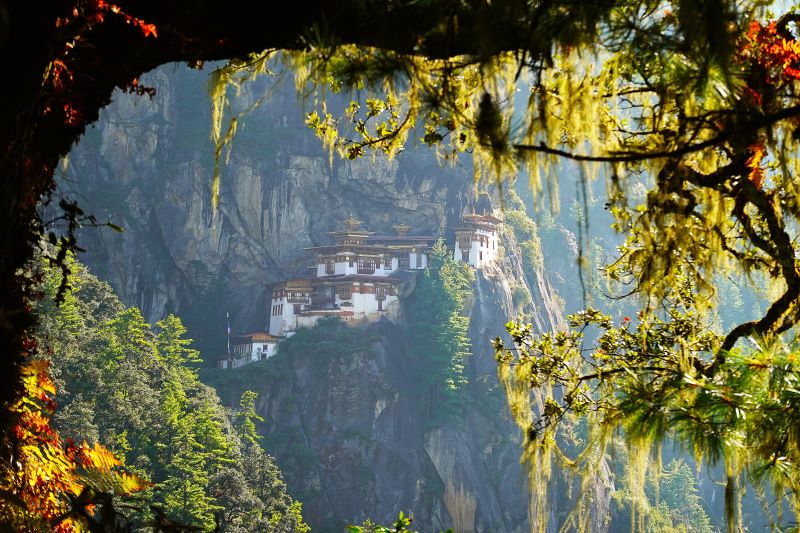
The monastery was very impressive, as it was built into the rock. It was built in the 16th century at an altitude of 3,120m. Inconceivable how this was possible at that time. According to Buddhist tradition, Guru Rinpoche flew to these rocks on a tiger to combat a demon. This ultimately gave the monastery its name. If you look closely, you can recognise the face of the demon in the rock. The Tiger’s Nest has burnt down twice in the past. The first time because of a fire in the valley and flying sparks, and the second time due to a butter lamp in 1994. The last reconstruction took 9 years. In 2004 was the reopening.
Altogether there were 9 temple rooms, of which we were allowed to visit 8. In one of the first rooms a Buddhist master was reading mantras and we were allowed to sit down and listen to him for a while. After visiting all the temple rooms, we had the opportunity to light butter lamps, before going back down towards the valley.
In the afternoon the two of us, i.e. without our guide, went for coffee in Paro and strolled through the shops, where we admired the many beautiful Buddhist statues. For dinner our guide had picked out an especially good restaurant, which he and our driver accompanied us to.
Day 12 – Goodbye Bhutan
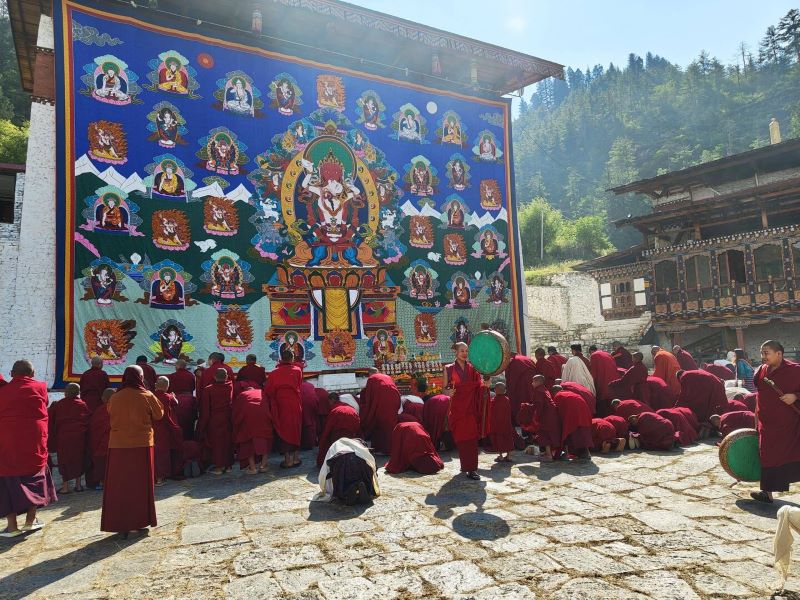
Today it was time to say farewell – but luckily only after lunch! As fate would have it, today in Paro was also the last day of a 7-day festival in honour of the god of long life. Next to the dzong of Paro, a huge silk picture of this god and other thematically fitting gods was hung on a building. We were early and waited with many arriving guests for the ceremony. We sat on the grass among the locals until the master, the governor and the monks from the dzong came to the festival ground. The monks first gathered in front of the great picture and prayed, as did many of the guests. Then everyone sat down on the grass opposite the picture facing the Buddhist master. The ceremony was opened with a fire dance by four monks. All visitors were given delicious rice that the monks distributed. The master read mantras and explained their content in the national language Dzongkha. Of course we did not understand anything. Our guide afterwards gave us a brief content summary of the sermons of the almost 3-hour ceremony. We found it very interesting. At the end, everyone present received a sip of holy water and a small piece of a kind of cake. Afterwards everyone was blessed by the master and other high-ranking monks. To do this, they walked through the rows and touched everyone on the head with sacred objects such as jugs and bowls. We sat right in the middle.
After the ceremony we visited a temple from the 14th century. The temple was built by a master who could build bridges out of steel – and that already 600 years ago! The architecture was different from all other temples we have seen so far. In the building there was a corridor around a three-storey tower that you could climb via steep wooden ladders. On the walls the original paintings from the 14th century could still be seen. A really impressive temple. For the last lunch our driver and the guide took us to a momo restaurant for locals. That was tasty! And, as is customary for the people in Bhutan, we received no cutlery but ate with our hands.
After the meal we headed to the airport. Saying goodbye was hard for us. The two of them made our trip in Bhutan an unforgettable experience. For that we are very, very grateful to them!
Thanks again for everything and all the best! Constanze and Peter