









 EN
EN
Tibet ist ein beeindruckendes Land
Vielen lieben Dank für die tolle Reise! Wir waren rundum begeistert von geoDiscovery Tours – schon vorab wurden wir gut vorbereitet und haben auch vor Ort eine reibungslose Orga gehabt!Für…
Read full report →
Nepal, Bhutan, Tibet, Ladakh, Tanzania, Kenya & Georgia tours

 Nepal
Nepal

This dream-like journey takes you into the Upper Dolpo region to Jomsom, over high passes to rarely visited places near the border with Tibet.
Upper Dolpo is one of the most untouched areas in the Himalayas — original, strongly Tibetan in character, remote and fascinating. Most trekkers walk the easier Dolpo circular route; we will walk along the more distant and challenging paths to Jomsom.
We begin the trek with a flight to Juphal. After a few days of steep hiking up the Suli Gaad Valley, we reach the lush fields of Ringmo. Next to this village lies the turquoise Phoksundo Lake. After a rest day to explore the lake, we continue our journey. We cross the Kang La to Shey Gompa and then cross two more passes, Saldang La and Jeng La. This brings us to Tokyu Gaon, near Dho Tarap. From Tokyu Gaon we begin our challenging 7-day trek eastward to Jomsom, over the Chhoi La, Chharka La and Sangda La.
Our routes are carefully planned. We always offer extra breaks and acclimatisation days so that you remain fit and healthy throughout.
This camping trek is a good choice if you have already done other demanding tours in Nepal and have very good health and physical fitness.
Travel information
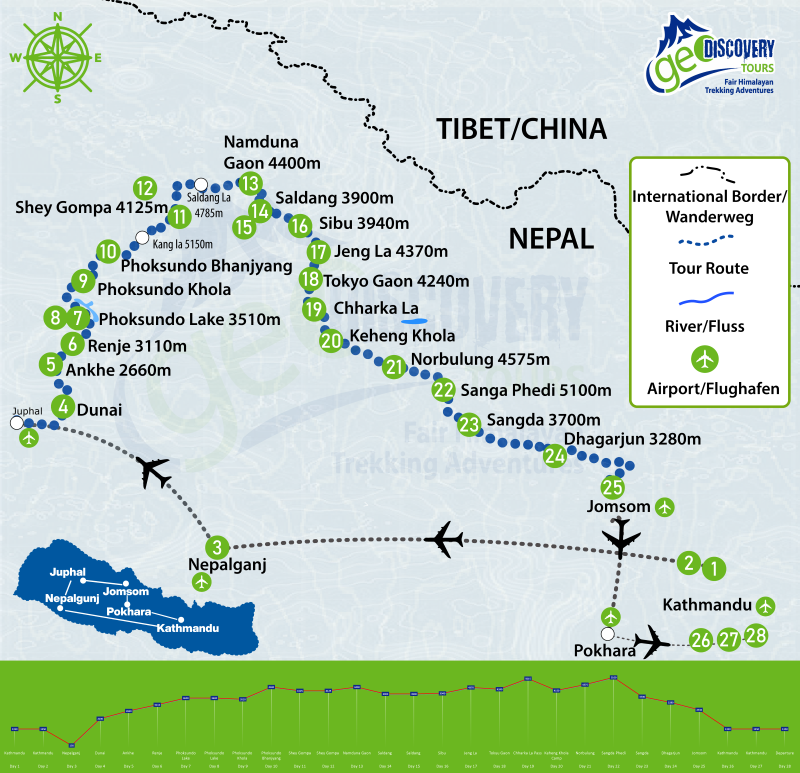
Arrival in Kathmandu. You will be picked up at the airport and driven to your hotel. In the afternoon we will discuss the course of the trip with you, and in the evening you are invited to a shared dinner with your mountain guide. Overnight at the Hotel Tibet or an accommodation of similar category (D).

Today we explore Kathmandu with a local guide. This day can be arranged flexibly according to your wishes. Among the most popular places and most impressive sights are Pashupatinath — a Hindu temple with cremation grounds, Swayambhunath — also known as the Monkey Temple — Boudhanath Stupa, Durbar Square and Thamel — the tourist centre of Kathmandu. You should return to the hotel in the late afternoon to pack for the trekking tour the next morning. You can also leave a bag at the hotel with items that you will not need on the tour. The rest of the day is at your leisure. Overnight at the hotel (B).
Early-morning transfer to the airport and flight to Nepalganj. The roughly 50-minute domestic flight takes us from the Kathmandu Valley down into the Terai plains in the south of Nepal. After arrival we are picked up and brought to the hotel. The rest of the day is available for relaxation or preparation for the onward journey the next day.
Overnight at the hotel (B).
We start early and take the 45-minute flight to Juphal. From the plane we have fascinating mountain views of Annapurna and Dhaulagiri. In Juphal we meet our trekking crew. After an early lunch we begin hiking. The trail leads down to the Bheri River, past terraced fields, and then follows the gorge to Dunai. Overnight at a tented camp (B|L|D).
We hike out of Dunai and cross the suspension bridge over another large river, which merges with the Suli Gaad coming from Phoksundo Lake. The trail follows a steep valley above the roaring river. Far up we reach Phoksundo National Park near the village of Hanke. Overnight at a tented camp (B|L|D).
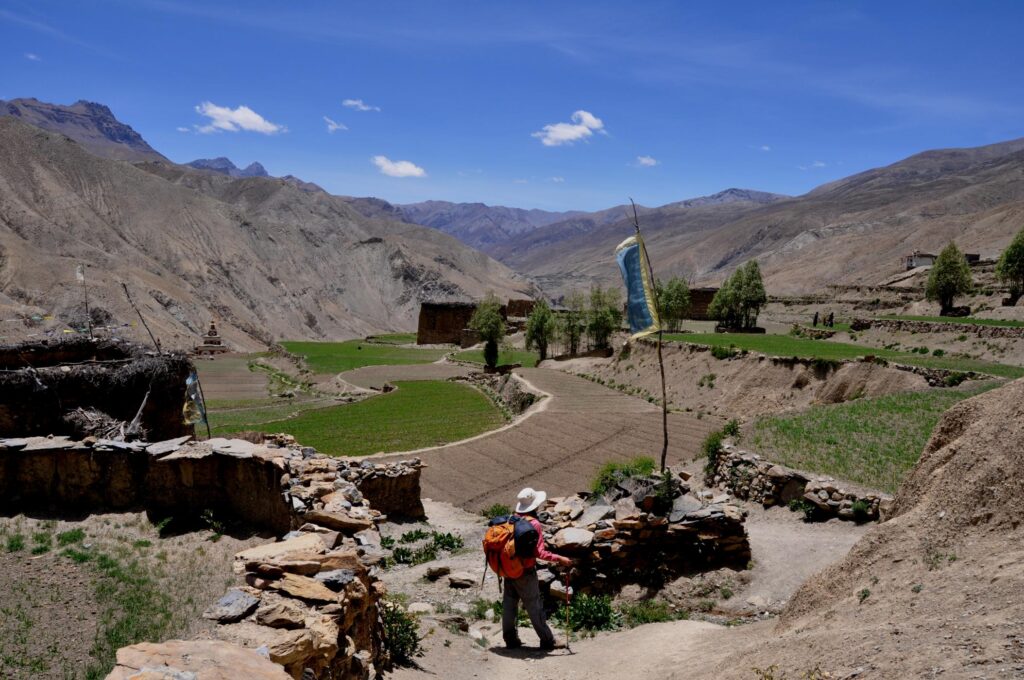
Today we change sides of the valley and cross several suspension bridges. Sometimes we walk right next to the river and sometimes high above the gorge. By the afternoon the valley broadens and we soon reach the bridge that leads to the village of Renje. Overnight at a tented camp (B|L|D).
The valley becomes flatter, and beyond Renje, from Sumdo, the trail climbs steeply to a ridge, from where we catch our first glimpse of the beautiful, turquoise Phoksundo Lake. From the ridge we descend through a forest before climbing back up to the village of Ringmo. We will pitch our camp directly by the lake. Overnight at a tented camp (B|L|D).

Today we can either visit the nearby Tibetan Buddhist monastery or take a walk along the lake. Overnight at a tented camp (B|L|D).
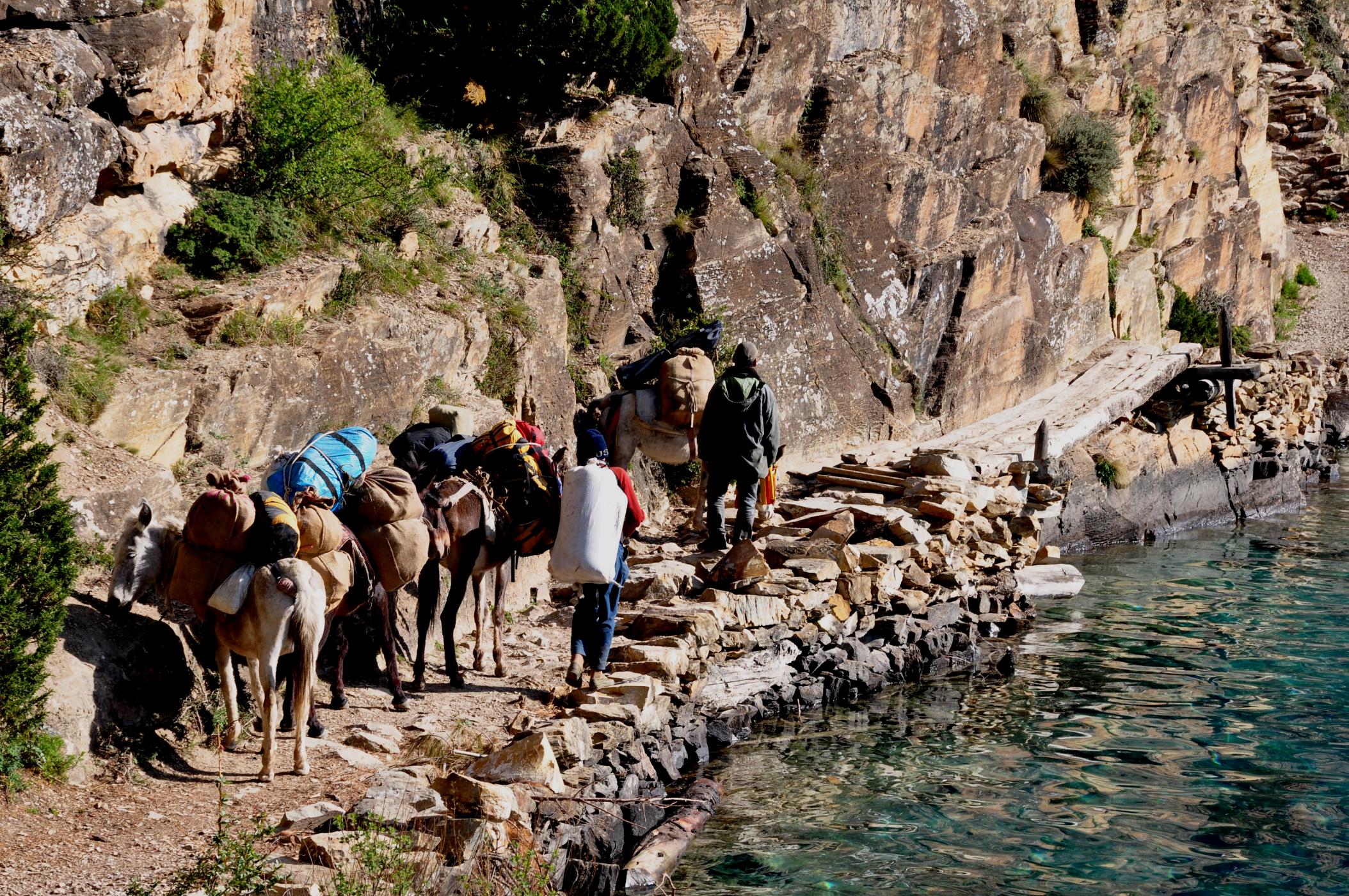
The path runs along the western side of Phoksundo Lake and is somewhat insecure, as in various sections it is only provisionally secured with wooden boards and rocks. However, this path treats us to breathtaking views of the blue lake, which is also featured in Eric Valli’s excellent film “Himalaya”. It is not possible to hike further north into the Inner Dolpo region without special permission. Once we have walked around the lake, the path leads into a wide valley and we pitch our camp by the Phoksundo River. Overnight at a tented camp (B|L|D).
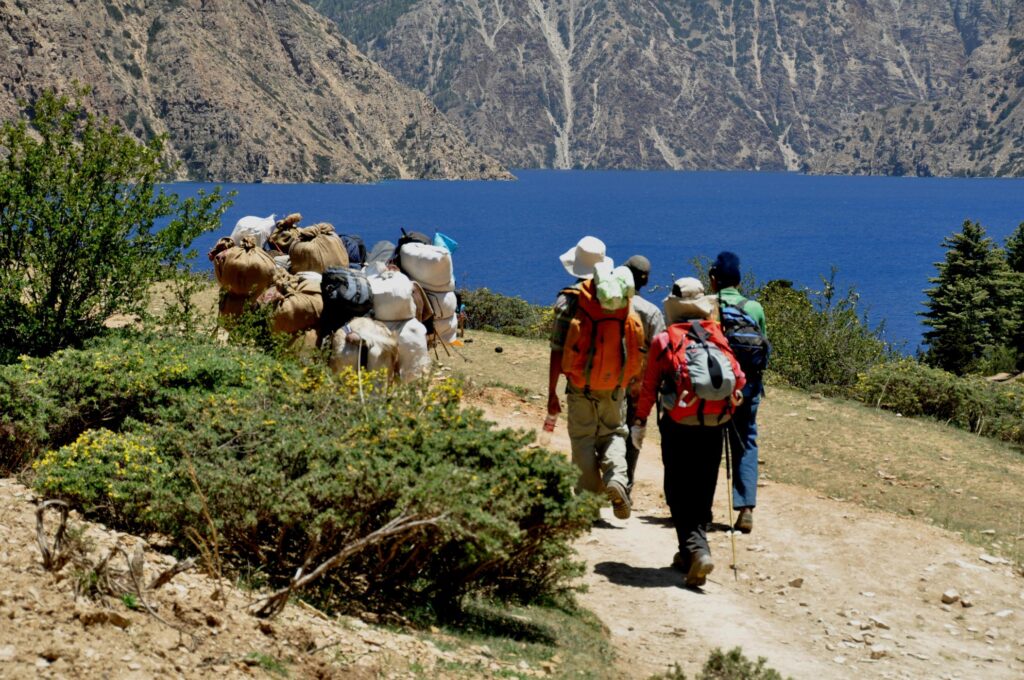
From camp we head north over into a flat valley, crossing a few streams along the way. It is advisable to have sandals to hand here, in case we need to wade through a few streams. We follow the same route that Peter Matthiessen took in his book The Snow Leopard, and today we camp at the place he called Snowfields Camp. This sits below the pass in the direction of Inner Dolpo. Overnight at a tented camp (B|L|D).
The path up to the Kang La Pass is quite steep and strewn with loose slate scree. This is followed by a steep descent to the valley floor, and the trail then leads across a riverbed to Shey Gompa. The famous Buddhist monastery sits below a crystalline summit – Shey means “crystal” in the local dialect. Overnight at a tented camp (B|L|D).

Today we have the chance either to explore the area or to relax at camp. Overnight at a tented camp (B|L|D).
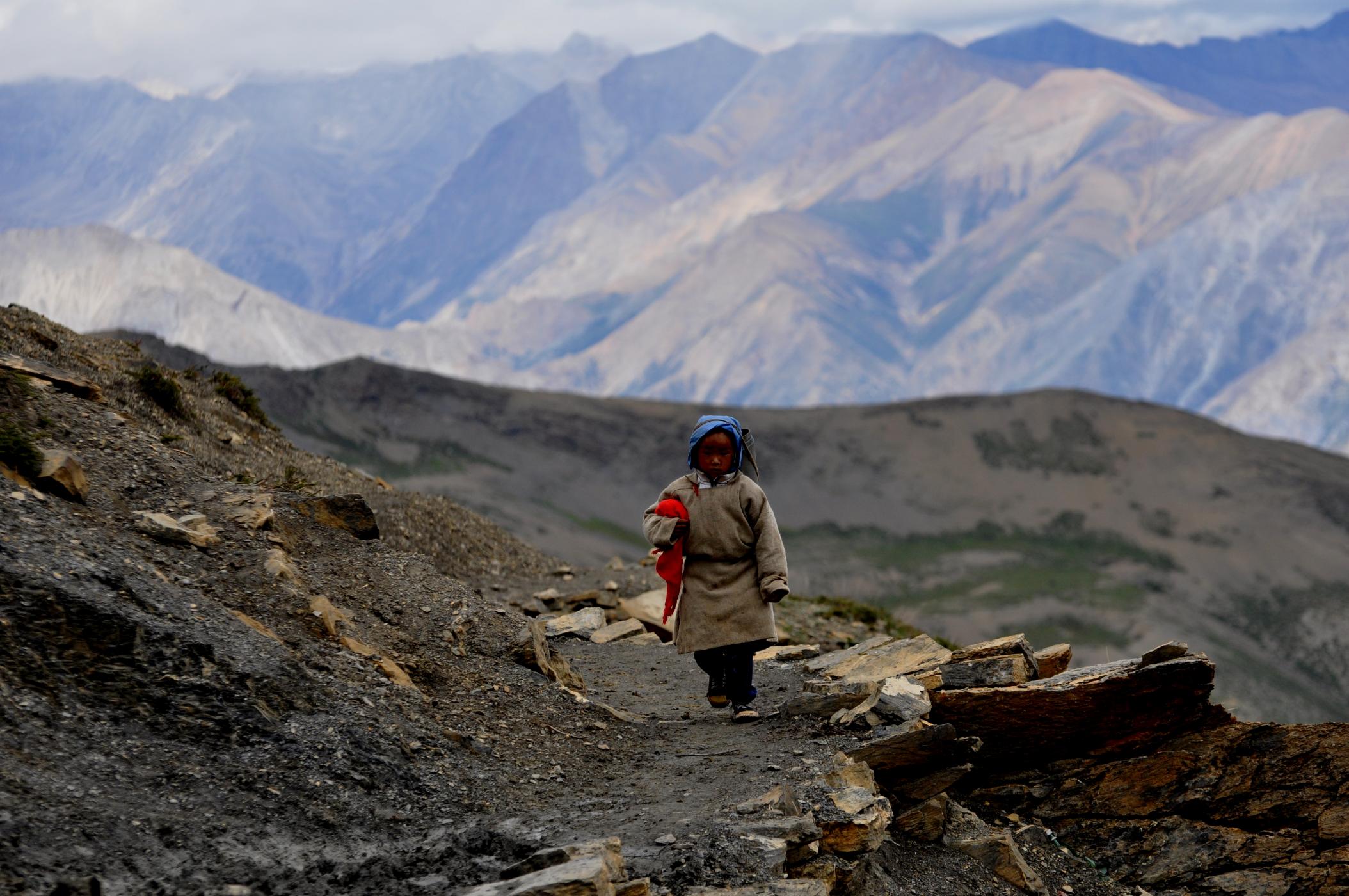
We leave Shey and begin to walk up a flat valley to the east. A steep ascent to the Saldang La awaits us. From the pass there are views to the north into Tibet and to the east into the Mustang region. We keep heading north and descend from the pass to a small settlement at Namgung. Overnight at a tented camp (B|L|D).
Today a shorter day awaits us. We cross the Namgung Khola before descending to the village of Saldang. This settlement is the largest in the inner Dolpo region and lies on the legendary salt trading route from Tibet to the southern lowlands. Overnight at a tented camp (B|L|D).
Today you again have the chance to explore the area on short walks or to relax at camp. Overnight at a tented camp (B|L|D).
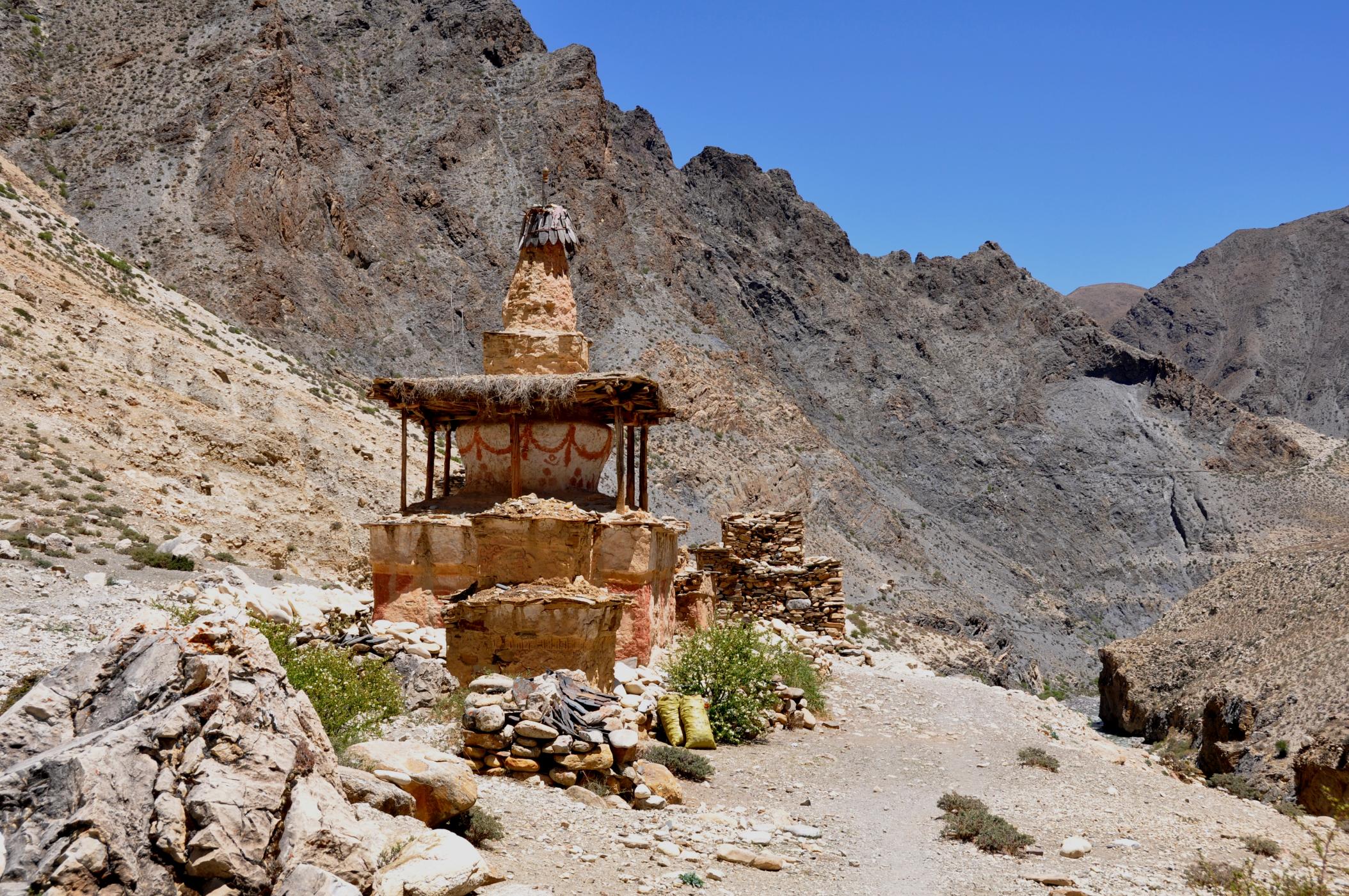
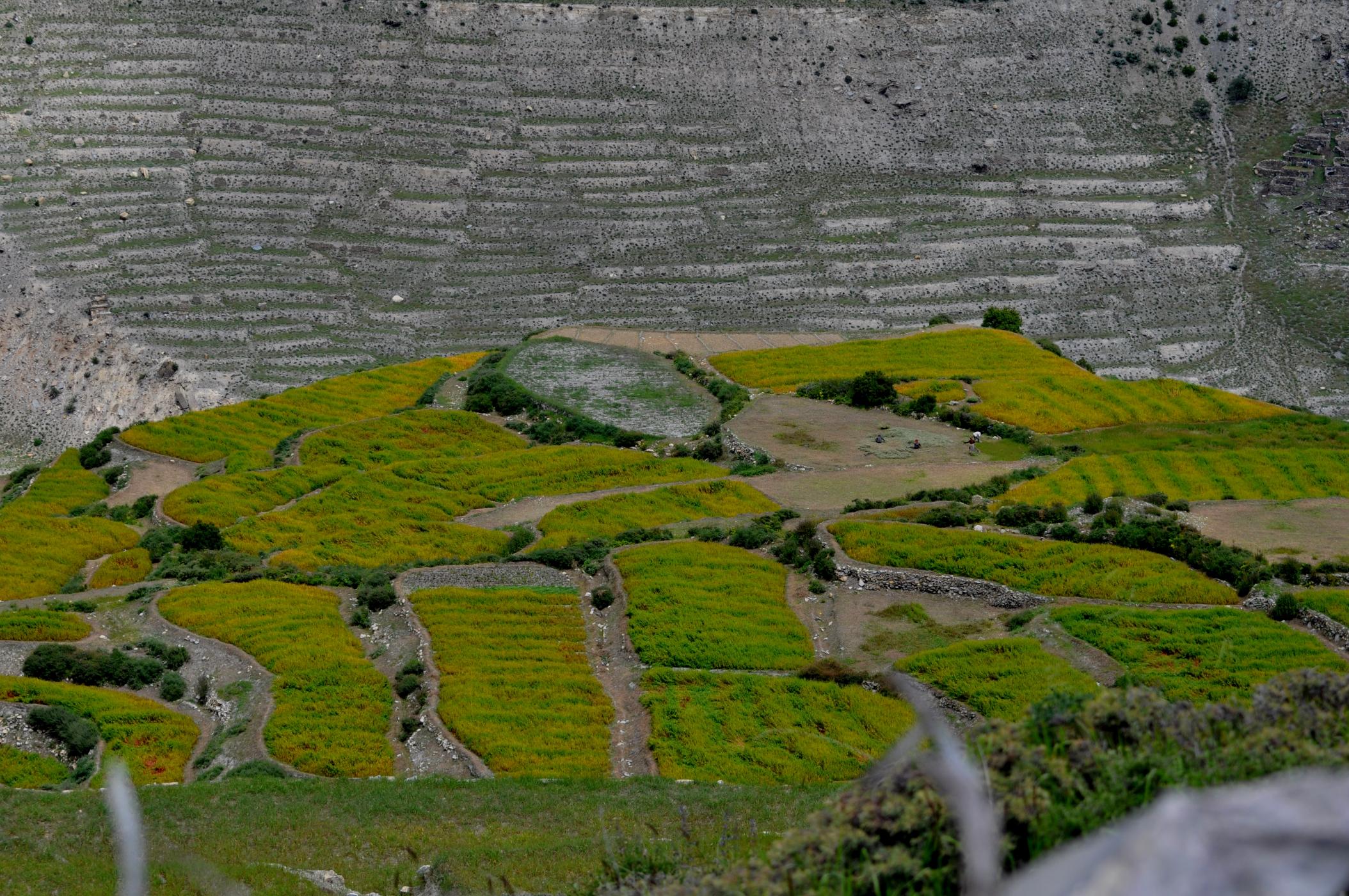
We leave Saldang and continue south. We follow the Namgung Khola and pass terraced fields and mani walls. Namdo is the next village and we walk on to the village of Sibu, where we pitch our camp for the night. Overnight at a tented camp (B|L|D).
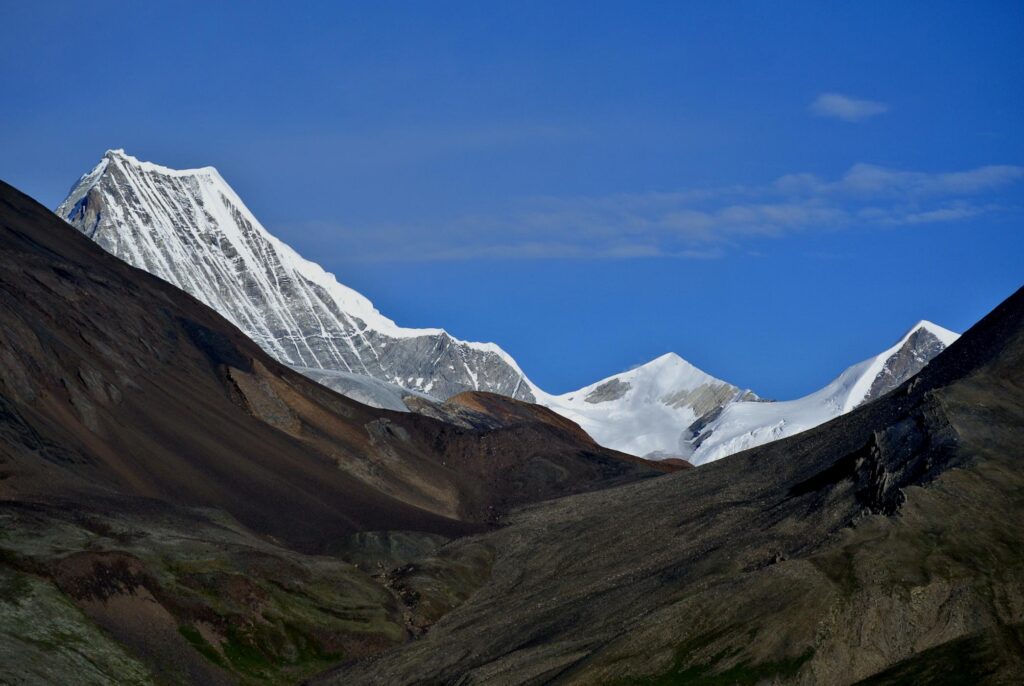
We follow the river in the main valley before turning into a side valley, where the path becomes steeper. We camp near a yak pasture also known as Langmo Che. Overnight at a tented camp (B|L|D).
It takes about 2 hours until we reach the Jeng La Pass at 4,845 metres. Up here, wonderful views of Dhaulagiri await us. We descend from the pass, reach the Tarap Valley and follow it to the village of Tokyu Gaon. Overnight at a tented camp (B|L|D).
This is the beginning of an adventurous trek eastward in the direction of Jomsom. On this section of the hike we cross a remote wilderness which only a privileged few are allowed to visit. As we walk from Tokyu Gaon to Dho Tarap, we see a typical village. We reach the Chharka La Pass; there the valley flattens out and here we pitch our camp for the night. Overnight at a tented camp (B|L|D).
We hike along the Tarpi Khola and reach the Chharka La. The descent from the pass is along a pebbly path, and soon the valley opens up and we see the Keheng Khola, where we will spend the night. Overnight at a tented camp (B|L|D).
The path continues eastward and after a short time we cross the Bharbung Kola on a small bridge and head north, along the Chharka Tulsi Kola. After about an hour we come to the small village of Chharka and continue on to the Thansan Khola, where we cross a small bridge to our camp at Norbulung. Overnight at a tented camp (B|L|D).
After the Norbulung camp we pass the high yak pastures of Molum Sumdo and continue on to a pass at exactly 5,000 metres of altitude. We walk further and begin the ascent to the Sangda La. On a pebbly path we descend to Sangda Phedi. Overnight at a tented camp (B|L|D).
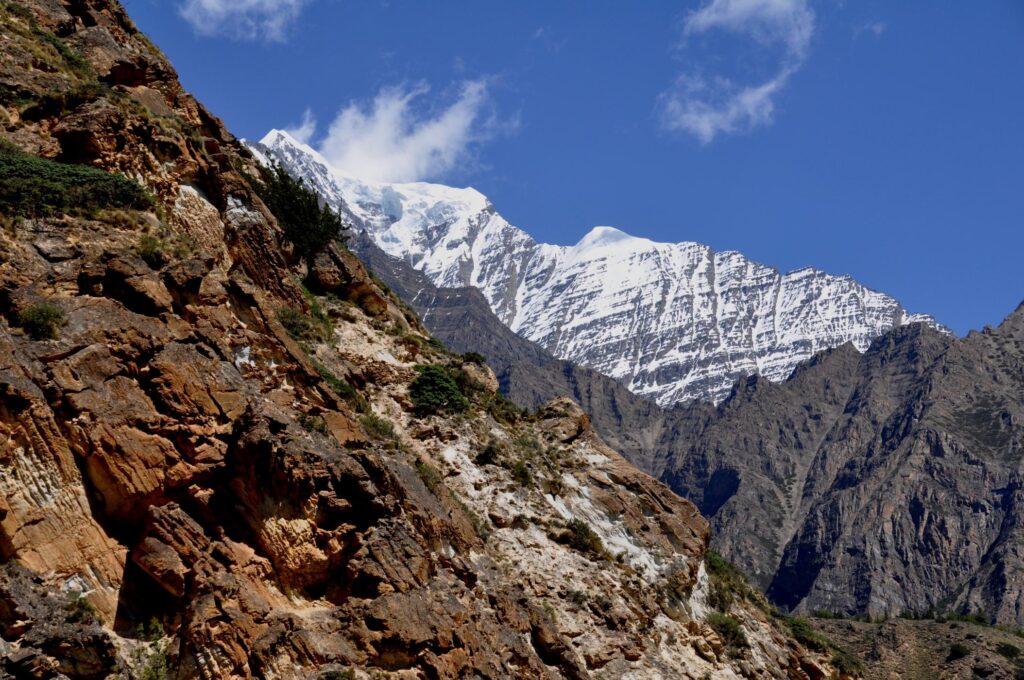
Today we cross another pass, with a descent over loose slate, and reach the settlement of Sangda. This lies at the junction of the Bheri Khola and the Kyalunpa Khola. It is then a few more hours to the village of Sangda. Overnight at a tented camp (B|L|D).
From Sangda we begin a climbing tour during which we cross several ridges until we reach the last pass at around 4,200 metres of altitude. Here we can enjoy magnificent views of Thorong La, Nilgiri, Dhaulagiri and the villages in the Kali Gandaki valley. Overnight at a tented camp (B|L|D).
We cross another pass on the way to Jomsom. The wind-blown place, with its small airstrip, lies on the immensely popular Annapurna Circuit route. Overnight at a tented camp (B|L|D).
We take the morning flight to Pokhara and then fly on to Kathmandu. You will be picked up at Kathmandu airport and driven to the hotel. Overnight at the Hotel Tibet or an accommodation of similar category (B).
Today is at your leisure, which you can spend relaxing, with further sightseeing or shopping in Thamel. A good last chance to pick up a few souvenirs at short notice. Overnight at the hotel in Kathmandu (B).
Farewell and transfer to the airport for the flight back home (B).
We reserve the right to make changes to the programme due to special events, force majeure or weather conditions.
B = Breakfast | L = Lunch | D = Dinner
Read what our guests share about their experiences on this and other tours.
Vielen lieben Dank für die tolle Reise! Wir waren rundum begeistert von geoDiscovery Tours – schon vorab wurden wir gut vorbereitet und haben auch vor Ort eine reibungslose Orga gehabt!Für…
Read full report →
Namaste – नमस्ते Dies war meine dritte Reise mit geoDiscovery Tours und bereits die zweite Reise nach Nepal. Vor zwei Jahren unternahm ich gemeinsam mit meinem Mann den Mardi-Himal-Trek im…
Read full report →
The enthusiasm for this holiday began with the planning. We rarely experienced a travel agency that offered an almost "24-hour all-round service" from Mrs. Kolay. Even the smallest details on…
Read full report →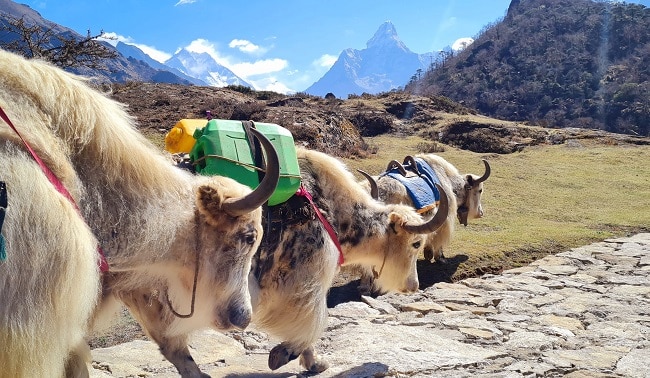
"Finally, after many years of longing and cancellations."The Himalayas have captivated me ever since I got hold of Peter Habeler's book "Der einsame Sieg" over 40 years ago. Now, finally,…
Read full report →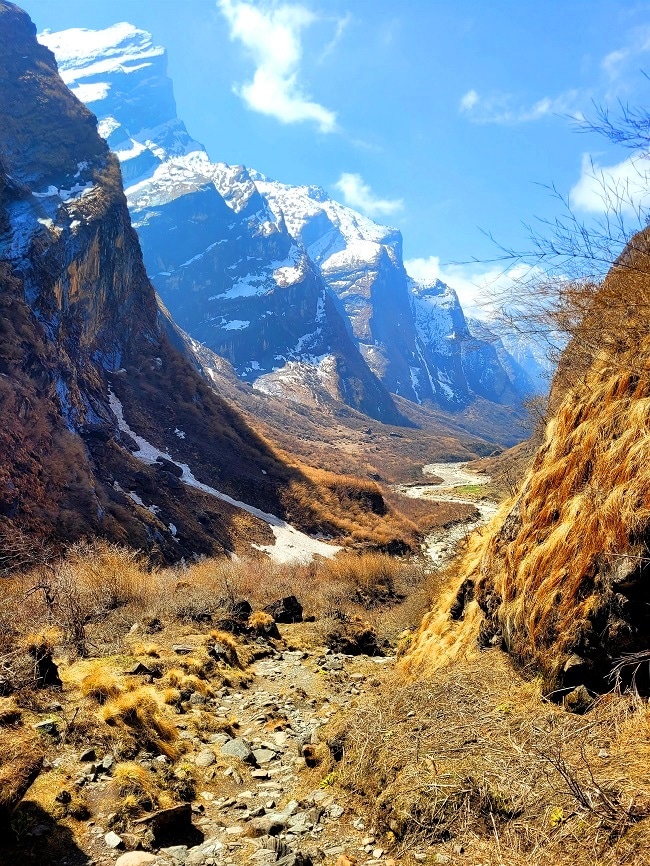
Nepal – a country with an exciting culture, beautiful landscapes and wonderful people. I travelled there for the first time and it definitely will not be the last. After we…
Read full report →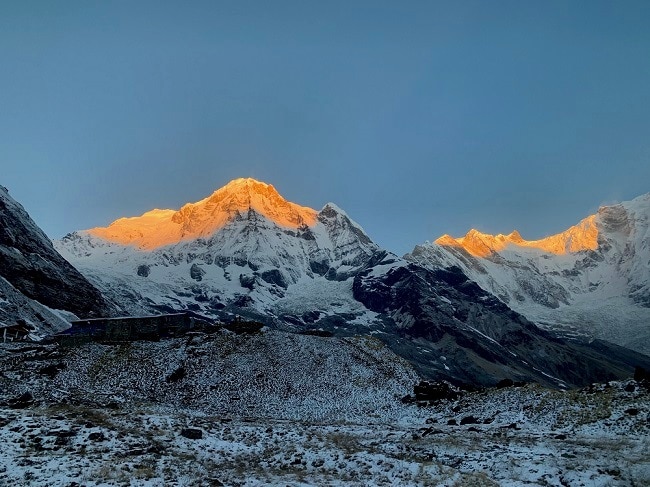
For around 20 years I have been dreaming of the Himalayas, and in April 2022 I was finally able to fulfil this dream with a trip to Nepal. After a…
Read full report →No mandatory vaccinations are required for entry into Nepal. The standard vaccinations (tetanus, diphtheria, polio, hepatitis A) are recommended. Depending on the duration and type of your trip, hepatitis B, typhoid and rabies may also be advisable.
We recommend that you always inform yourself before and during your trip about the current security situation and travel advice on the website of the German Federal Foreign Office: www.auswaertiges-amt.de
The Nepal visa is paid for and issued upon entry at Kathmandu Airport. You can apply for it online in advance (“Visa On Arrival” application only) via the official form: nepaliport.immigration.gov.np. Please print out the confirmation and bring it with you.
Alternatively, the visa can also be applied for in advance at a Nepalese consulate in your home country.
Fees (as of 2026):
15 days: 30 USD · 30 days: 50 USD · 90 days: 125 USD
Payment in USD, Euro or NPR (credit cards usually not accepted).
The best time for trekking in Nepal is spring (March–May) and autumn (October–early December) with stable weather, clear views and ideal conditions.
Autumn: Pleasant temperatures, the best long-distance views, fresh greenery.
Spring: Mild climate and spectacular rhododendron blossom (especially March/April).
Winter (December–February): Off-season with clear views and few trekkers – ideal for those who can handle the cold.
Monsoon (June–September): Trekking only possible in dry regions such as Upper Mustang and Upper Dolpo.
Travel health insurance including rescue and recovery costs is essential for your own safety and a prerequisite for booking our trips. Taking out trip cancellation and trip interruption insurance is strongly recommended. Particularly cheap flights are usually not free to rebook or cancel. In addition, weather-related or health complications in Nepal may make it necessary to cut a trip short.
We have asked ERGO Reiseversicherung to put together various coverage packages for you. You can book the right travel health insurance at www.reiseversicherung.de .